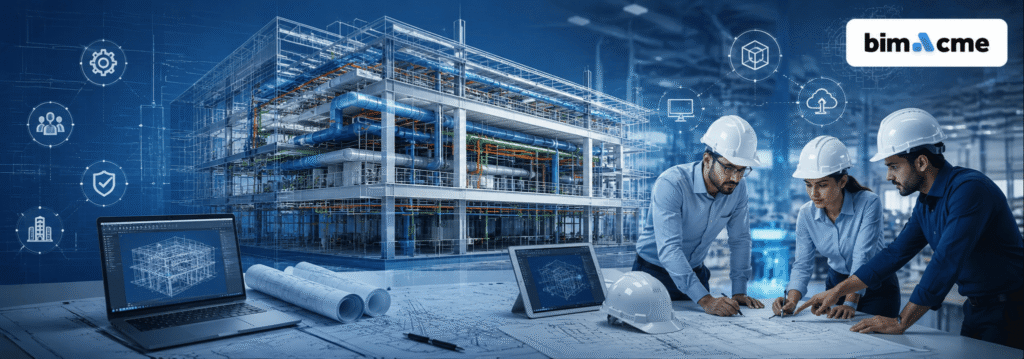
You are working on a high-stakes construction project and have a detailed MEP BIM model before you on the screen. The model looks remarkable on the screen. But soon, you encounter the harsh practicalities of the model!
The pipes clash with a structural beam. The electrical layout doesn’t match site conditions. The HVAC system cannot be installed as designed.
Finally, you realise something. MEP 3D Modelling isn’t a standalone element. It is just as good as the people, processes and technology that run it.
Undoubtedly, Building Information Modelling (BIM) transforms how mechanical, electrical and plumbing systems are designed.
However, the software application alone cannot guarantee an accurate, constructible or useful model. The model delivers value only when the right people, processes and technologies work together. So, here are seven factors that determine the success of MEP BIM modelling.
Transforming Data into Intelligent Models
Think of the most advanced BIM platform. It is smart in every sense. Yet, it is only a tool. It cannot operate automatically. You need experienced BIM modellers, engineers and coordinators to use it effectively.
An MEP professional’s understanding must go beyond 3D components. It should also extend to comprehending system behaviour, construction requirements, design intent, building regulations and installation constraints.
For instance, besides location, while placing an HVAC duct, the modeller must consider clearance, access, maintenance requirements and coordination.
Expert MEP BIM Modelling Services that combine technology with human expertise help transform a digital model into a practical construction solution.
Well-Defined Processes that Create Consistency
BIM projects are highly complex. Hence, a single broken link, a missing element in a workflow, or a poorly defined process can quickly get out of control. Different teams may follow different modelling standards, file structures, detailing levels, or nomenclatures.
A structured BIM process helps you establish how information is created, checked, shared and updated throughout the project. It can include BIM execution plans, modelling standards, information exchange procedures, review cycles and approval workflows.
A well-defined, consistent process curbs ambiguity. It fosters uniformity that enables architects, structural engineers, MEP consultants, contractors, etc., to work from the same information.
Strengthening the Foundation with Design Information Accuracy
BIM models rely on information. Hence, the more accurate the information, the stronger the BIM model. Models based on obsolete architectural drawings, incorrect dimensions, incomplete specifications, or inaccurate manufacturer data can result in critical modelling errors. These mistakes can affect coordination, quantity take-offs, and construction documentation.
This is where teams, precisely people, come into play. They must verify drawings, specifications, and survey information, along with other relevant project inputs before the modelling process begins.
Coordination Leads to a Constructible Model
MEP 3D modelling helps identify clashes before the construction process begins. But effective clash detection requires more than just running a software check. Seasoned BIM coordinators must understand which clashes are real and which ones are acceptable based on specific project needs. Besides, they must prioritise conflicts and work with other disciplines to build practical solutions.
Accordingly, effective MEP BIM Coordination can recognise conflicts between ducts, pipes, cable trays, structural elements and architectural components before they become costly concerns.
Improving Efficiency with the Right Technology
Although not standalone, technology is yet another significant aspect of the MEP BIM modelling equation. Modern BIM platforms, clash detection tools, cloud collaboration systems, laser scanning and reality capture technologies help improve project accuracy and efficiency. But the goal must not be to use technology only because it is available. The technology must support the project’s objectives and help you accomplish the desired goals.
Ensuring Interoperability and Common Data Environments
Projects seldom use a single software package. Architects, structural engineers, and MEP subcontractors usually work across different platforms. Utilising OpenBIM standards (such as IFC) alongside a centralized Common Data Environment (CDE) ensures smooth, seamless data exchange.
However, when software systems fail to communicate, you may lose critical MEP data in translation, resulting in costly errors during site installation.
Preventing this is possible when you have the right people onboard who ensure technologies run optimally and maintain the project’s integrity.
Providing Continuous Training and Ensuring Adaptability
BIM standards, software features, and digital workflows evolve continuously. Companies that invest in ongoing upskilling for their personnel adapt quickly to modern methodologies. MEP BIM modelling services empower teams with the right training programs to leverage new capabilities effectively.
Looking for MEP BIM Modelling Services that Blend People, Processes and Technology?
Then, Bimacme, one of the most trusted names in MEP 3D modelling, is here to help. We manage complex projects across various domains and diverse geographies, helping our clients manage the MEP aspect of the project efficiently. We emphasise integrating people, processes and technologies, and aligning each with the project’s expected outcomes to drive optimal results.
So, unleash the true meaning and impact of MEP BIM modelling with Bimacme. Please email us at info@bimacme.com to enter into a detailed dialogue with our MEP BIM experts. We will be glad to assist you.